10 Madrid Attractions: A Personal Ranking with Prices and Practical Tips
In Short
If you are visiting Madrid for the first time, the hardest task is not finding attractions but deciding which ones deserve a place in your itinerary. The city offers enormous classical museums, palaces, churches, parks and a growing number of immersive cultural spaces.
This ranking is presented in reverse order and is based on our personal experience. Number 10 is the place that impressed us least, while number 1 offered the strongest and most enjoyable experience.
Prices and temporary exhibition dates were checked as of 15 June 2026. Always confirm them on the official website immediately before your visit.
If you need a ready made program see also Madrid in 7 days.
Number 10: Plaza Mayor and Puerta del Sol
Plaza Mayor is one of the most recognisable squares in Madrid’s historic centre. It is surrounded by arcades, traditional restaurants and the imposing Casa de la Panadería.
At its centre stands the equestrian statue of King Philip III, completed by Pietro Tacca in 1616 and moved to the square in 1848.
Puerta del Sol is the lively centre of Madrid and the location of the Kilometre Zero plaque, from which Spain’s main national roads symbolically begin. Look for the statue of the Bear and the Strawberry Tree, the symbol of Madrid, the equestrian monument to King Charles III and the replica of the Mariblanca statue.
Recommended visiting time: approximately 30-60 minutes for both squares
Price: free
Why they are in 10th place: They are essential for a first visit and for photographs, but the experience is more of a short walk through the busy centre than a separate attraction requiring several hours.
Number 9: Parque de El Retiro
Retiro Park is one of the symbols of Madrid and a good place for a walk, particularly when combined with a visit to the Prado or Reina Sofía. The park is extensive, with a lake, wide avenues, monuments, gardens and plenty of places to rest.
I have placed it in ninth position because it can become extremely hot in summer, while Palacio de Cristal is closed for restoration until 2027. You can still see it from outside, but you may be disappointed if you expected to enter and visit a temporary exhibition.
The Crystal Palace was built in 1887 as a greenhouse for an exhibition dedicated to the Philippines. Its glass and metal structure was inspired by London’s Crystal Palace.
Recommended visiting time: 1.5-3 hours
Price: free
Best for: walking, relaxing and combining with museums around Paseo del Prado
Important: Palacio de Cristal is closed for restoration until 2027.
Number 8: Nomad Museo Inmersivo
Nomad is suitable for visitors who enjoy digital art, projections, music and visual effects. Its programme changes regularly, so check which exhibition is showing on the day of your visit.
In June 2026, the programme included experiences dedicated to artists such as Monet, Kandinsky, El Greco, Velázquez and Goya. These exhibitions are not substitutes for seeing the original paintings but offer a different way of presenting them through movement, sound and large-scale projections.
Nomad is a good option for a hot afternoon, a rainy day or a change of pace after visiting several traditional museums.
Recommended visiting time: 30-60 minutes
Adult price from Monday to Friday: €18
Adult price at weekends: €21
Discounts: available for children, students, people with disabilities, unemployed visitors and people over 65
Address: Gran Vía 78
Number 7: Catedral de Santa María la Real de la Almudena
Almudena Cathedral is located opposite the Royal Palace and can easily be included in a walking route through Madrid’s historic centre. Its interior stands out for the colourful modern style of its murals and stained-glass windows, which makes it dramatically different from Europe’s older Gothic cathedrals.
The main cathedral is free to enter, with a recommended donation. The museum, sacristy, chapter house and dome require a separate ticket, so check where the free entrance is if you do not wish to visit the museum.
The dome offers views of the Royal Palace and western Madrid. This is one reason not to limit the visit to a quick look inside the main church.
An interesting fact is that construction continued for more than a century. The cathedral was finally consecrated by Pope John Paul II in 1993.
Recommended visiting time: 30-45 minutes
Cathedral admission: free, with a recommended donation
Museum and dome: €8
Reduced ticket: €5 with the required supporting document
Number 6: Matadero Madrid
Matadero Madrid is a former municipal slaughterhouse and livestock market transformed into one of the city’s most important centres for contemporary and experimental art. The complex reopened to the public with its new cultural purpose in 2007 while preserving its industrial architecture and characteristic brick pavilions.
There is no single permanent museum exhibition. The different buildings host temporary exhibitions, digital experiences, theatre, cinema, dance performances, festivals, artistic events and creative residencies.
It is therefore important to check the programme in advance and decide which spaces you want to visit.
(Super)Models and the Contemporary Mayrit Guernica
Until 21 June 2026, Nave Una hosted the exhibition (Super)Models, a central part of Mayrit, Madrid’s Biennial of Design and Architecture.
The exhibition explored different “models” that influence how we perceive the contemporary world, including economic systems, algorithms, propaganda, technologies, national symbols and social roles.
One of the most memorable works was Mayrit Guernica by Adad Hannah. The installation follows the approximate composition of Picasso’s Guernica but transforms it into a three-dimensional work made from local, everyday and reused materials.
It was built over ten days with the participation of volunteers from Madrid. This collective process is an important part of its meaning: a group of strangers comes together to create a shared anti-war message that contrasts with the violence and destruction depicted in Picasso’s original painting.
The Immersive Cleopatra Experience
MAD – Madrid Artes Digitales is located in Nave 16, in the digital arts section of the complex. Until 19 July 2026, visitors could experience Cleopatra, la exposición inmersiva.
The exhibition followed the life of the last great ruler of Ancient Egypt, placing her story in the context of struggles for power, relations with Rome and the changes taking place in Egypt during her reign.
The experience included 360-degree projections, digital spaces, interactive scenes and holographic images. Its strongest section came in the final room, where visitors received VR headsets and entered a virtual reconstruction of Alexandria.
You walk through Cleopatra’s palace, pass people in the streets and move through spaces that appear visually realistic. At certain moments, it may feel as though you are walking above an abyss, even though you are physically standing on a flat and safe floor.
Members of staff monitor each visitor’s movement and provide guidance to prevent disorientation or collisions with the walls. This makes it easier to immerse yourself in the experience without constantly worrying about your location in the real room.
During our visit, the combination of (Super)Models and Cleopatra created a varied experience, ranging from political and conceptual contemporary art to a visually spectacular VR walk through ancient Alexandria.
Recommended visiting time: 2-4 hours, depending on the exhibitions
General complex admission: access to public spaces is free
(Super)Models: free entry until capacity is reached
Cleopatra: paid ticket, with prices depending on the day and time
(Super)Models end date: 21 June 2026
Cleopatra end date: 19 July 2026
Best for: contemporary art, digital experiences, architecture and teenagers
Tip: Check the programme for the different halls because Matadero Madrid is not a single museum with one general ticket.
Number 5: SOLO Independencia and “Helnwein: mundos invertidos”
SOLO Independencia is located near Puerta de Alcalá and can easily be missed unless you already know about it. The space is smaller and more intimate than the major national museums, and visits require an advance reservation.
Helnwein: mundos invertidos was the first major exhibition in Spain dedicated to Austrian-Irish artist Gottfried Helnwein. His works combine children’s faces, hyperrealism, popular culture, historical violence and disturbing imagery.
The exhibition included some of Helnwein’s emblematic works alongside pieces by more than 30 other contemporary artists. This created a dialogue between his visual language and a range of contemporary perspectives.
His art is not pleasant in the traditional sense, but it makes you look closely and continue thinking about what you have seen long after the visit.
Recommended visiting time: 60-90 minutes
Price: free with advance reservation
Exhibition end date: 30 July 2026
Important: places are limited.
Number 4: Museo Reina Sofía
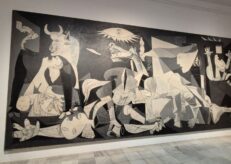
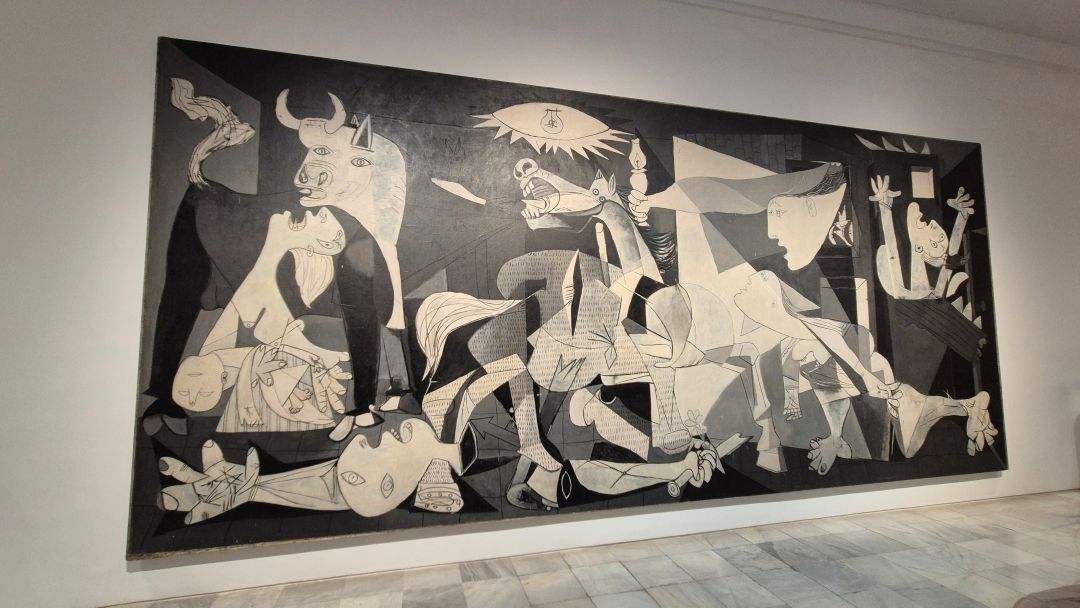
Reina Sofía is one of Madrid’s most important museums and the city’s main destination for Spanish modern and contemporary art. Its most visited work is Pablo Picasso’s Guernica.
Guernica was created for the Spanish Pavilion at the Paris International Exhibition in 1937. The painting returned to Spain only in 1981, after the restoration of democracy.
It expresses the suffering, chaos and horror of war through powerful symbolic figures. Painted in a Cubist language using black, white and grey, it creates an overwhelming feeling of nightmare and grief.
Picasso began the work after reading reports about the tragedy in the small Basque town of Guernica in northern Spain. On 26 April 1937, during the Spanish Civil War, the town was subjected to a devastating aerial bombardment by the German Condor Legion and Italian forces acting in support of General Francisco Franco.
Interesting fact: The canvas was painted in black, white and grey, a choice that allowed Picasso to imitate the rough visual effect of newspaper photography. His aim was to make the message resemble a raw documentary report that the world could not ignore.
Do not enter only to see the painting and immediately leave. Explore the works, photographs and documents around it, which explain the Spanish Civil War, the bombing of Guernica and the creation of the masterpiece.
Before moving on to the rest of the museum, compare Picasso’s original Guernica with African Guernica by Dumile Feni, displayed until 22 September 2026. The South African work transfers the anti-war and anti-totalitarian message into the context of apartheid.
If you also visited (Super)Models at Matadero Madrid, you can add Adad Hannah’s Mayrit Guernica to the comparison. This is a three-dimensional collective interpretation made from reused materials.
Within a single journey, you can therefore see how Picasso’s iconic composition continues to be used to examine war, violence and political oppression.
Afterwards, look for the rooms featuring:
- Pablo Picasso, including paintings in his characteristic expressive styles;
- Salvador Dalí, particularly the more unusual works from his early period, some of which differ greatly from his familiar Surrealist imagery and even show Cubist influences;
- Joan Miró;
- Juan Gris;
- Maruja Mallo;
- Spanish avant-garde movements;
- art connected with the Civil War and exile.
The location of individual works may change, so collect an updated map or use the museum’s application.
Recommended visiting time: 2-3 hours
Standard ticket: €12
Free admission: during the final two hours before closing; a ticket is still required, and advance booking is advisable
Closed: Tuesday
Tip: For a calmer visit, choose a time between 2:00 p.m. and 6:00 p.m.
Number 3: Royal Palace of Madrid
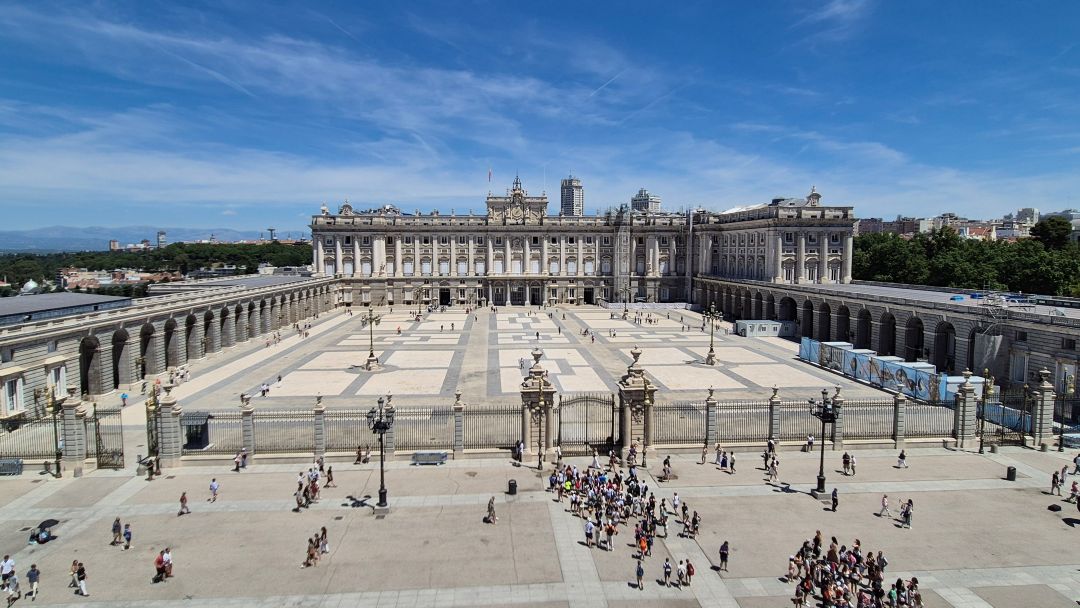
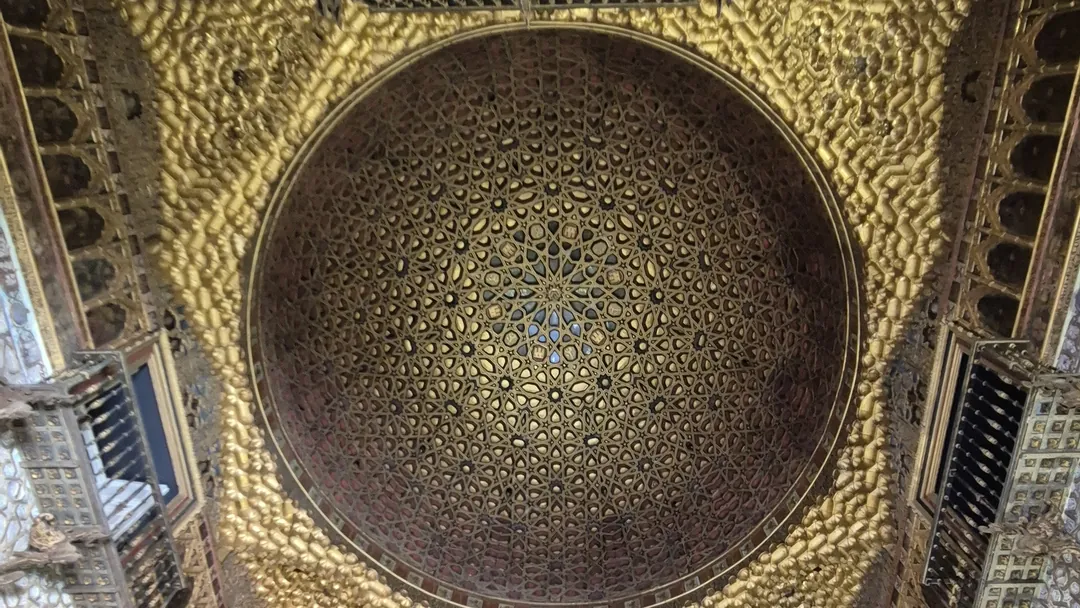
The Royal Palace is one of Madrid’s most imposing landmarks. The route passes through ceremonial rooms, royal apartments and interiors where the furniture, ceilings, tapestries and decorations form part of a complete visual spectacle.
The Spanish royal family does not live here permanently. The palace continues, however, to be used for official receptions, state dinners and ceremonies.
This means that individual sections may close without extensive advance notice. Check the current programme immediately before your visit.
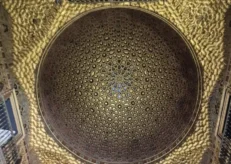
For me, the Royal Palace of Madrid and the Real Alcázar of Seville are the most impressive royal residences in Spain.
Whenever possible, combine the palace with Almudena Cathedral, Plaza de Oriente and Mirador de la Cornisa.
Recommended visiting time: 1.5-2.5 hours
Standard ticket: €18
Reduced ticket: €9
Free admission: Monday to Thursday during selected afternoon hours for EU citizens and other eligible categories
Required document: identity card, passport or another official document proving eligibility
Tip: Buy a ticket for a specific time.
Number 2: Museo Nacional del Prado
The Prado is enormous, and there is little value in trying to see everything during a first visit. After several hours, concentration decreases and you begin walking mechanically past works that deserve much more attention.
Choose several principal highlights in advance.
Room 12 and “Las Meninas”
Diego Velázquez’s Las Meninas is one of the most analysed paintings in the history of art. It is simultaneously a royal portrait, an everyday scene and a complex game involving perspective, reflection and the position of the viewer.
Stand farther away first to understand the complete composition, and then move closer to examine the individual faces and details.
“The Garden of Earthly Delights” by Bosch
Hieronymus Bosch’s triptych is a work in front of which you can remain for a long time. The more closely you look, the more strange creatures, symbols and miniature scenes you discover.
It demonstrates why the Prado is not only a museum of Spanish painting.
Goya’s Black Paintings
The Black Paintings are among the most powerful and disturbing works in the museum. They were originally painted directly onto the walls of Goya’s house and were later transferred to canvas.
Look for Saturn Devouring His Son and the other works in the cycle.
More Important Works
Allow time for:
- The Third of May 1808 by Goya;
- The Descent from the Cross by Rogier van der Weyden;
- works by El Greco;
- Velázquez’s royal portraits;
- Titian;
- Rubens;
- Francisco de Zurbarán.
The Prado’s collection is largely the result of the personal tastes and commissions of Spanish monarchs rather than an attempt to represent the entire history of art evenly.
Recommended visiting time: at least 3 hours, preferably 4
Standard ticket: €15
Reduced ticket: €7.50
Free admission: during the final two hours before closing
Tip: Use the official “Three Hours in the Museum” route or create your own list.
Number 1: Balloon Museum | Euphoria Madrid
The Balloon Museum was the most enjoyable and immediate experience in our programme. This is not a museum where you walk quietly past paintings and read labels.
At Euphoria, you move through large-scale installations created with air, light, sound and inflatable forms. Some of the artworks can be touched and physically experienced.
The attraction is suitable for:
- families with children;
- teenagers;
- contemporary art enthusiasts;
- people who enjoy photography;
- adults who are prepared to participate and play.
Do not wear overly formal or uncomfortable clothes. In certain areas, you may need to move actively, sit down, bend or enter the installations themselves.
The Balloon Museum has previously presented projects in different cities around the world. Its format combines art, entertainment and active audience participation.
Recommended visiting time: approximately 90 minutes
Tickets: from €21 for adults and from €15 for children
Madrid end date: 6 September 2026
Location: Escenario Puerta del Ángel, Casa de Campo
Tip: Reserve a specific time and arrive punctually.
How to Buy Tickets for Madrid Attractions
For the Prado, Reina Sofía, the Royal Palace and the Balloon Museum, it is sensible to buy tickets online. This saves time and reduces the risk of your preferred entry time being unavailable.
Before purchasing, check:
- whether free admission is available;
- whether you qualify for a discount;
- which supporting document you must present;
- whether temporary exhibitions are included;
- whether the ticket can be changed or refunded;
- which entrance you should use.
If you are interested in our experience with Madrid food and places to taste it, check up What and Where to Eat in Madrid: Spanish Food and 9 Personally Tested Places
Where to Stay in Madrid
We stayed in an artistic apartment in Malasaña. The location was very convenient for walking, restaurants, bars and public transport.
The accommodation had significant advantages as well as important disadvantages: it was on the fourth floor without a lift, had a steep staircase leading to the attic bed, a low ceiling and street noise.
You can read the detailed review in “Artistic Apartment in Malasaña, Madrid: An Honest Review for 4 Guests.”
I recommend booking your stay directly here. For your convenience, I have added a map box showing available rooms in hotels, apartments and other places to stay. You support the blog without paying more, and you can still use all your Genius and other discounts.
How to find all these places?
Just tap the pins on my map and follow the directions.
Frequently Asked Questions
What Is the Most Important Attraction in Madrid?
For lovers of classical art, it is the Prado. For history and palace interiors, choose the Royal Palace. For a lighter and more interactive experience, visit the Balloon Museum.
Can the Prado and Reina Sofía Be Visited on the Same Day?
It is possible, but I do not recommend it. Both museums require concentration, and after several hours, you may begin to experience the art mechanically rather than meaningfully.
Which Madrid Attractions Are Free?
Retiro Park and the main section of Almudena Cathedral are free. The major museums and the Royal Palace also offer selected free-entry periods under specific conditions.
Should Tickets Be Purchased in Advance?
Yes, particularly for the Royal Palace, the Prado, Reina Sofía, SOLO Independencia and temporary immersive exhibitions.
Which Attraction Is Best for Teenagers?
The Balloon Museum is the most interactive choice. Nomad is also suitable for visitors who prefer digital experiences to traditional museum displays.
Is Retiro Worth Visiting While Palacio de Cristal Is Closed?
Yes, if you want a walk, greenery and a place to rest. If your primary purpose is to enter the Crystal Palace, it may be better to wait until the restoration is complete.
To continue planning your trip
You can also read the other articles in my Madrid series: Madrid in 7 days: a personal guide, practical Madrid travel tips for transport, tickets and safety, what and where to eat in Madrid, a review of the artistic apartment in Malasaña, Toledo from Madrid in one day, Segovia from Madrid in one day, train travel in Spain and my personal ranking of Alcázars and palaces in Spain.
Follow the blog on social media too: TikTok, Instagram, Facebook, YouTube, LinkedIn, X.