Segovia Day Trip from Madrid: Train, Aqueduct, Cathedral and Alcázar
In Short
Segovia is one of the easiest and most enjoyable day trips from Madrid. The city is more compact than Toledo and offers an almost linear route – from the Roman Aqueduct, through the central streets and the Cathedral, to the fairy-tale Alcázar.
Segovia is quick to reach by high-speed train. However, it is important to know that Segovia-Guiomar station is located outside the historic centre, and after arriving you need to take a city bus to the Aqueduct.
Segovia is a good choice when you are looking for impressive sights, an easier route, fewer climbs and a lower overall budget for entrance fees.
Toledo or Segovia – when should you choose Segovia?
To me, Toledo and Segovia felt different enough to make both worth visiting. Segovia is easier to explore, and the route is more logical.
If your stay in Madrid is around a week, the best option is to set aside one day for Segovia and a separate day for Toledo.
Train tickets from Madrid to Segovia
Before travelling, check the train timetable and, if possible, buy your tickets online. This way you can calmly compare departure times, prices and the amount of time you will have there.
Do not forget to reserve the return journey as well. A one-way ticket does not guarantee that you will find seats on a convenient train back in the evening.
How early should you arrive at the station?
Even if you have already bought your tickets in advance, allow at least 30-45 minutes to find your platform and have enough time for the security check.
With fast trains, the platform is sometimes shown on the departure board relatively close to the departure time. That is why it is not a good idea to wait in a café at the other end of the station without keeping an eye on the information.
If you do not have tickets and plan to buy them at the station, I recommend arriving even earlier than your preferred departure time. There is always a risk that tickets for your chosen train may no longer be available, especially at weekends.
Buying tickets at the station
If the ticket-purchasing website feels confusing or you are not sure which station the train departs from, you can buy a ticket from a Renfe customer service centre.
Look for the large offices marked in the company’s characteristic purple colour. Usually, you take a numbered ticket, and when your number appears on the screen, you go to the indicated desk.
To buy a train ticket, you need an identity card or another identity document. It also confirms whether you are entitled to a discount.
You explain to the staff member where you want to travel, on which date, at what time, that you want a return ticket and how many people you are. It is also a good idea to clarify whether children, school pupils or students are travelling, because there may be discounts, but they usually require a document.
The disadvantage of buying at the last moment is that there may be no convenient departure times left or only more expensive tickets may remain.
Which railway companies should you check for Segovia?
For Segovia, compare the railway companies Renfe and OUIGO.
Both companies offer fast trains to Segovia-Guiomar station. OUIGO sometimes has very good prices when booked early, but the number of convenient times may be more limited.
Buy from the official websites or apps and carefully check the exact station in Madrid, the ticket change conditions, luggage allowance, return time, whether the ticket is personal and what identity document is required.
Frequency: Renfe has trains approximately every hour, and during peak periods every 20-30 minutes. The first train usually departs around 06:30, and the last return train is around 22:15. On Saturdays and Sundays, there may also be a train around 23:00. OUIGO has only a few services per day, and Segovia is an intermediate stop.
Tickets and prices: Renfe prices are usually in the range of around €5 to €30, while OUIGO may be around €16 for an adult, depending on the day and time.
Duration: around 25 minutes.
Comfort: Renfe offers basic comfort, and various sources claim that it is higher than that of OUIGO. OUIGO trains are double-decker, have less space between the seats, but are often cheaper.
You can find more details about rail transport in Spain in the article “Travelling by Train in Spain: Tickets, Companies, Luggage and Practical Tips”.
You can find more details about rail transport, operators, luggage and how to navigate train stations in my article “Travelling by Train in Spain: Tickets, Companies, Luggage and Practical Tips”.
How do you get from Madrid to Segovia?
Fast trains to Segovia mainly depart from Madrid Chamartín-Clara Campoamor station and arrive at Segovia-Guiomar, which is around 5 km outside the historic city.
An alternative is the Avanza bus from Moncloa. The journey is longer, but the bus arrives close to the historic centre and the Aqueduct.
How do you get from Segovia-Guiomar to the centre?
Segovia-Guiomar station is located outside the historic centre. After arriving, look for city buses 11 or 12. Line 11 goes towards Acueducto, while line 12 goes towards Centro.
Line 11 is the most convenient for the classic sightseeing route because it drops you off at the Aqueduct.
The special ticket from the AVE station costs around €2.25. Check the signs and ask the driver if in doubt.
Important clarification: the stop is called Acueducto, not Viaducto.
Recommended Segovia itinerary for one day
The historic route is almost linear:
- the Roman Aqueduct;
- continue along Calle Real to see the other sights;
- Casa de los Picos – you will see it on the way to the Alcázar;
- Plaza de Medina del Campo;
- Plaza Mayor;
- Segovia Cathedral;
- lunch at El Sitio;
- Alcázar de Segovia;
- the Jewish Quarter – only if you still have time and energy after the walking route;
- return to the Aqueduct and take the bus back to the station.
This is one of Segovia’s great advantages. You do not need to keep returning to the same places or finding your way through a maze of streets.
The Roman Aqueduct in Segovia
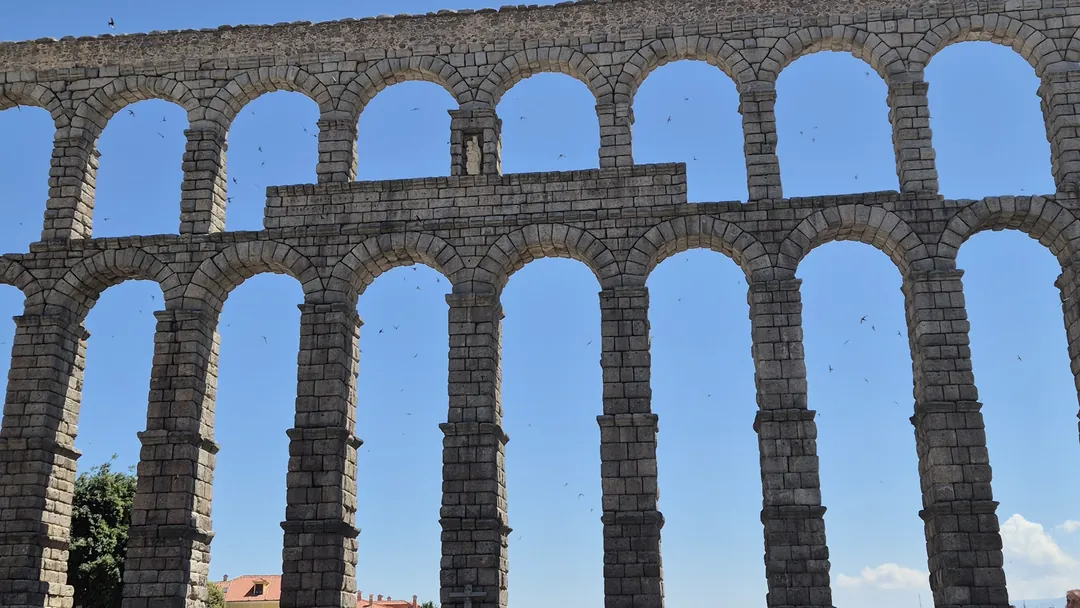
The Aqueduct is the first major sight you see after getting off bus 11. Its most impressive section passes over Plaza del Azoguejo and reaches almost 30 metres in height.
It was built in the 2nd century AD from more than 24,000 granite blocks. It was repaired in the 15th century and carried water all the way until the end of the 20th century.
The granite blocks are arranged without mortar, and the structure holds thanks to their precise shape, weight and the distribution of pressure. This is one of the reasons why the construction impresses even people who are not usually interested in engineering history.
Climb up to the upper viewing areas on the side to see the channel and the panorama over the city.
Opening hours: accessible at any time
Price: free
How much time to allow: 30-45 minutes
Casa de los Picos
Casa de los Picos is a 15th-century building whose façade is covered with hundreds of diamond-shaped granite stones. They give it both a decorative and almost defensive appearance.
The building belonged to the de la Hoz family, and today it houses a school of art and design. The main experience is the exterior façade, so you do not need to plan a long visit.
Price: free to view from the outside
How much time to allow: 10-15 minutes
Notice the esgrafiado on the façades
As you walk along Calle Real or other streets, look not only at the landmarks, but also at the walls of ordinary buildings. Many of them are decorated with Segovia’s characteristic esgrafiado.
With this technique, layers of plaster in different colours are applied to the wall. The upper layer is cut according to a pattern to reveal the lower one and create repeating geometric or plant ornaments.
Esgrafiado is not a single museum attraction, but part of Segovia’s overall appearance. Once you notice it, you begin to look for it on almost every façade.
Segovia Cathedral
The Cathedral rises next to Plaza Mayor and is known as the Lady of Cathedrals because of its elegant proportions and pale stone.
It is one of the last major Gothic cathedrals built in Spain. Construction began in the 16th century, after the old cathedral was badly damaged during the Revolt of the Comuneros, also known as the War of the Communities of Castile.
Opening hours Monday to Saturday during the active season: 09:00-21:30
Sunday: 12:45-21:30
Last entry: 30 minutes before closing
Standard ticket: €4
Reduced ticket: €3
Free admission: for children under 8, people with a disability above 65% and certain local categories
How much time to allow for the main cathedral: around 45 minutes
The discount is available for people over 65, students under 25, large families and people with a certain degree of disability.
Bring a document proving your age, student status, large-family status or degree of disability.
Is the Cathedral tower worth it?
It is possible to visit the tower, but it was closed during our visit, so I cannot say anything from personal experience. I have heard that the visit is guided, lasts around an hour and offers panoramic views over the city.
The ticket is around €7.
If you also plan to climb the Alcázar tower, consider whether you have the energy and time for two climbs in one day.
Where to eat in Segovia – El Sitio
El Sitio is conveniently located near Plaza Mayor and offers traditional local cuisine. The place is touristy, but practical for a one-day itinerary.
Some dishes can be ordered as tapas or as a full portion. The waiters may recommend the large portions, but if you want to try several different things, do not be easily persuaded.
In our case, the food became too much even from the tapas portions, and we had to take some of it away. Smaller portions are definitely more reasonable when a group is sharing several dishes.
What should you try in Segovia?
Cochinillo asado
Roast suckling pig is Segovia’s most famous speciality. The skin should be thin and crispy, while the meat should be tender and juicy.
Traditionally, in some restaurants, the piglet is cut with the edge of a plate to show how tender it is. It is a striking ritual, but it is not a guarantee that every restaurant offers the same quality.
Judiones de La Granja
Judiones are very large white beans cooked in a thick stew with meat and sausages. In the version we tried, I think there was tripe and sausage inside.
If you want to try both the suckling pig and the beans, order small portions for sharing. The combination of the two in full-size portions can turn out to be too heavy for lunch in the middle of a sightseeing walk, especially in the heat.
Ponche segoviano
For dessert, look for ponche segoviano – a cake with sponge, cream and marzipan. It is quite sweet, so one portion may be enough for two.
We did not try it because we had seriously overeaten at the restaurant.
Alcázar de Segovia
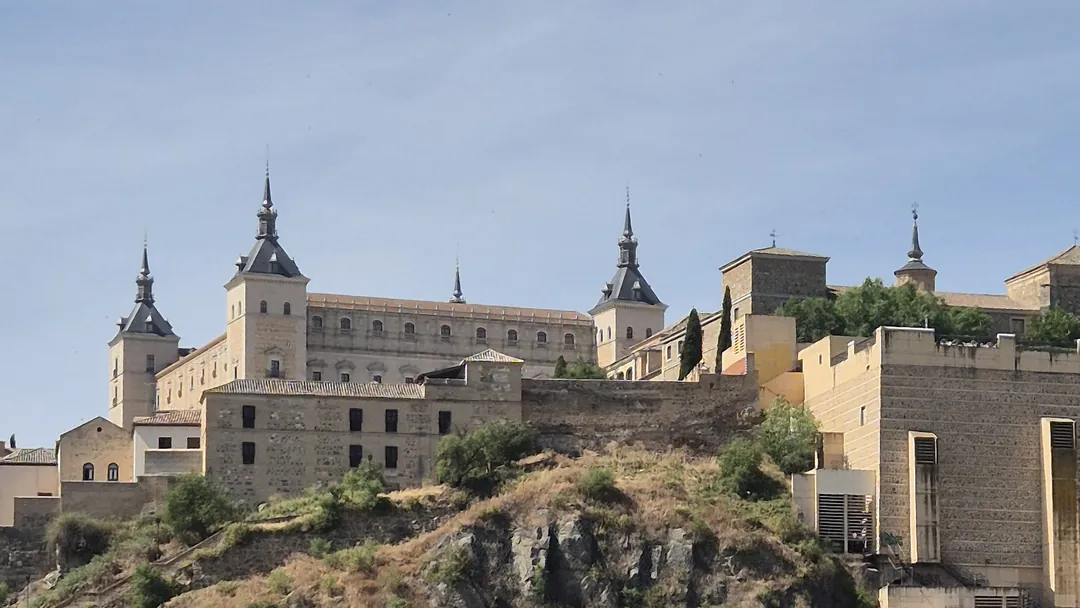
The Alcázar is built on a rocky outcrop between the valleys of the Eresma and Clamores rivers. Its silhouette resembles the bow of a ship and is one of the most recognisable views in the city.
Inside, you can see palace rooms, decorated ceilings, a throne room, royal chambers and a museum connected with the history of artillery.
An interesting fact is that Isabella of Castile left the Alcázar to be proclaimed queen in 1474. The castle is also often associated with inspiration for fairy-tale palaces in cinema and animation.
Opening hours from 1 April to 31 October: 10:00-19:30
Opening hours from 1 November to 31 March: 10:00-18:00
Last entry: 30 minutes before closing
Check the special dates, because in 2026 there are separate days with shorter opening hours or full closure.
Prices:
- standard ticket – around €7, although it may be more expensive;
- reduced ticket – around €5, although it may be more expensive.
Free access to the palace and museum is offered on Tuesdays from 14:00 to 16:00 for citizens of the European Union, with a ticket from the ticket office and subject to available capacity. An identity document is required.
The top of the tower is reached by a spiral staircase with 152 steps. The climb is not suitable for people with knee problems, limited mobility or strong claustrophobia.
The view is worth it, but do not underestimate the effort after a whole day of walking.
How much time to allow:
- 45-60 minutes without the tower;
- 75-90 minutes with the tower.
What would I skip in Segovia if time is limited?
Do not get pulled into an organised panoramic tour
The main route from the Aqueduct to the Alcázar is compact and easy to follow on foot. If you have no difficulty walking, there is no need to pay for a tour just to see the four main sights.
There is no need to climb both towers
The Cathedral and the Alcázar offer tower visits. For a day trip, I would choose only one instead of spending two hours on stairs.
Do not choose the first tourist menu near the Aqueduct or on the main street
The area around the Aqueduct is very touristy. Do not choose a restaurant only because it has a photo of suckling pig and a menu in several languages.
Check the prices, portion sizes and whether there is an option to order tapas if you want to try more dishes.
I tried to choose a restaurant outside the main routes, but in the end El Sitio also turned out to be quite touristy.
The Jewish Quarter
If you are very tired, you can skip it, because there are slopes and climbs there, and it is not that impressive.
See also my personal comparison between the Alcázars in Toledo, Segovia and Seville and the Royal Palace in Madrid.
How much budget should you plan for Segovia?
Without including the train and food, the approximate budget for the main visits is:
- bus from the station – around €2.25 each way;
- Aqueduct – free;
- Casa de los Picos – free from the outside;
- Cathedral – €4;
- Alcázar with tower – around €10.
Segovia is more suitable if you want strong sights with a lower overall budget.
Practical tips for a day trip to Segovia
Buy your outbound and return tickets at the same time and check which station in Madrid your specific train departs from. Arrive at the station at least 30-45 minutes in advance and bring an identity document.
Bring the original documents for student, age-based or other discounts. Save the tickets on your phone, but also take a screenshot. A portable charger is also very useful because throughout the day you will be using navigation, tickets, photos and possibly translation.
Wear comfortable shoes and do not plan the main museums for the final hour. Check holidays and religious events that may change opening hours. In hot weather, bring water, sunscreen and a hat.
Do not try to combine Segovia and Toledo in one day. The two places deserve separate itineraries.
How to get to all these places?
Use this map, specially created by placescases.com for your convenience.
Where to stay in Madrid?
You can read the detailed review of the place where we stayed in Madrid in the article “Artistic Apartment in Malasaña, Madrid: An Honest Review for 4 Guests.”
I recommend booking your stay directly here. For your convenience, I have included a box with a map showing available rooms in hotels, apartments and other accommodation options. You support the blog without paying more, while still using all your Genius and other discounts!
Frequently asked questions about Segovia from Madrid
Can Segovia and Toledo be visited in one day?
Technically, it is possible to pass through both cities, but it is not worth it. You will spend a large part of the day in transport and will not have enough time for the main sights.
Visit them on two separate days.
Is Segovia suitable as a first day trip from Madrid?
Yes. Segovia is easier to organise than Toledo because the route is compact and almost linear.
Is Segovia suitable for a family with teenagers?
Yes. Segovia may be more interesting because of the Aqueduct, the Alcázar and the easier route. The city is less tiring for a day trip.
Which station does the train to Segovia depart from?
Fast trains to Segovia-Guiomar usually depart from Madrid Chamartín-Clara Campoamor.
Are there companies other than Renfe?
Yes. For Segovia, compare Renfe and OUIGO. OUIGO sometimes has good prices, but fewer convenient times.
Should I buy the tickets in advance?
Yes, especially for a weekend, holiday or a specific return time. Buying early gives you more choice and sometimes a lower price.
If you like improvising, you can buy a ticket at the station before departure, but you risk waiting or finding no tickets available at the weekend.
How do you get from Segovia-Guiomar to the Aqueduct?
Take city bus 11 to the Acueducto stop. Line 12 is another option for getting to the centre.
What should I try in Segovia?
The most characteristic dishes are cochinillo asado and judiones de La Granja. For dessert, look for ponche segoviano.
Which city is cheaper – Segovia or Toledo?
Segovia is usually cheaper for sightseeing. Toledo has more separate paid sites, and the total cost can easily increase.
Is the Alcázar in Segovia worth it?
Yes. The Alcázar is one of the most recognisable landmarks in the city and combines a fairy-tale silhouette, palace rooms, history and views.
Is it worth climbing the Alcázar tower?
Yes, if you have no problem with narrow stairs, heights or tiredness after a long walk. There are 152 steps to the top, but the view is one of the strongest parts of the visit.
To continue planning your trip
If you would like to use a ready-made 7-day itinerary for Madrid, see also Madrid in 7 days.
You can also read the other articles in my Madrid series: Madrid in 7 days: a personal guide, 10 Madrid attractions: a personal ranking, practical Madrid travel tips for transport, tickets and safety, what and where to eat in Madrid, a review of the artistic apartment in Malasaña, Toledo from Madrid in one day, train travel in Spain and my personal ranking of Alcázars and palaces in Spain.
Follow the blog on social media too TikTok, Instagram, Facebook, YouTube, LinkedIn, X.